A Sample Calibration Session
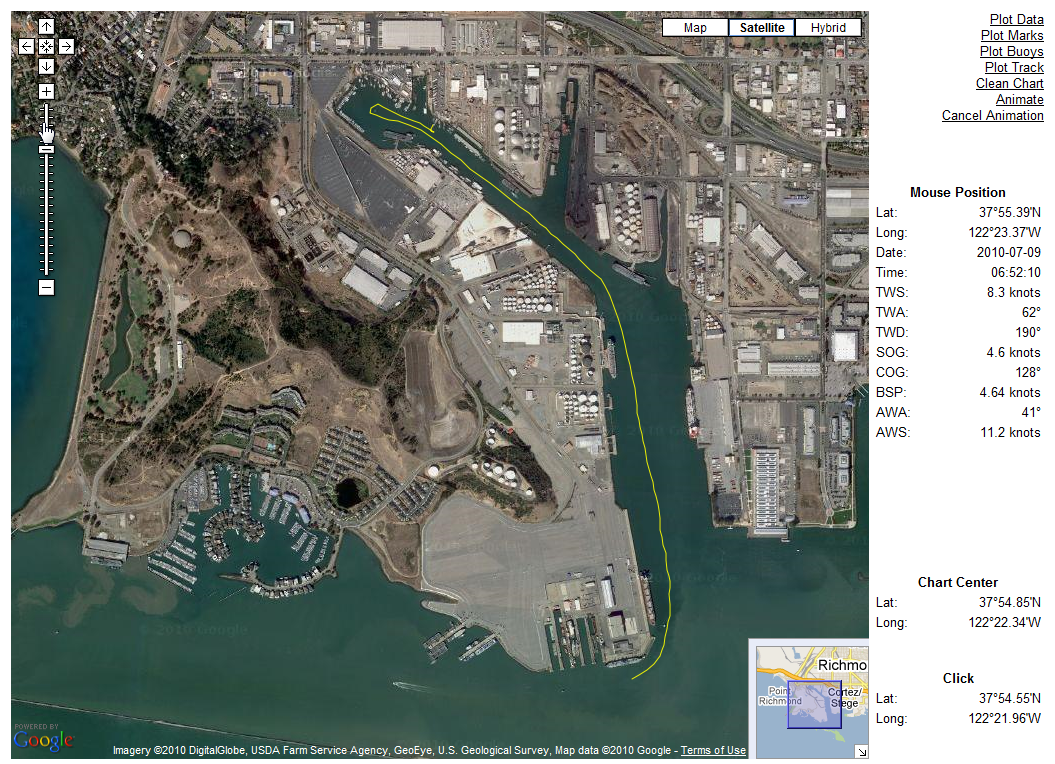
Let's take a real life example. This happened after installing new electronic on the boat, the logging was done from
Richmond to Oyster Point. The first part of the logging happened in a sheltered place, motoring, in no current.
As we said before, usually, the two most important calibrations are the boat speed and the deviation curve.
The wind speed (given by the mast head unit (MHU)) is usually OK, as is can be set at the factory. (this is not the
case for the wind angle, the wind vane being shifted by the sails underneath).
The boat speed - unlike the wind speed - depends a lot on the place on the hull where the transducer has been set.
The speed of the water on the tranducer does not necessary reflect the boat speed.
In a nutshell, if transducer is set in front of the main beam, the speed read by the transducer will be higher than the boat speed,
as the water accelerates as the hull becomes wider.
Along the same lines, if the transducer was set behind the main beam (which is very unusual on a sail boat), the speed read at the
transducer would be lower than the actual boat speed, as the water slows down as the hull becomes narrower.
What is the coefficient to apply to the boat speed read by the transducer? This is the whole point of our calibration.
1. Boat Speed and Heading
For this purpose, it is important to log data in a sheltered place, with no current.
If this can be done motoring, this will allow us not to deal with the leeway, which we can consider as null.

You define a segment of the logging to reflect the part where you were motoring in a sheltered place.
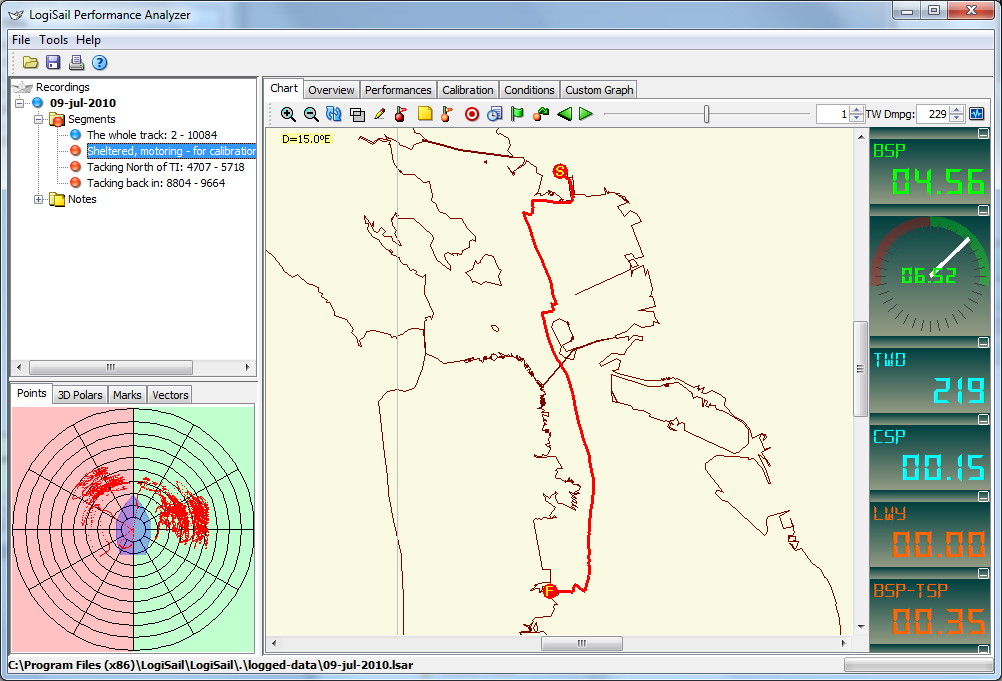

We can see that the wind is far from being steady. Taking notes when logging can help to remember if that was
the case or not...
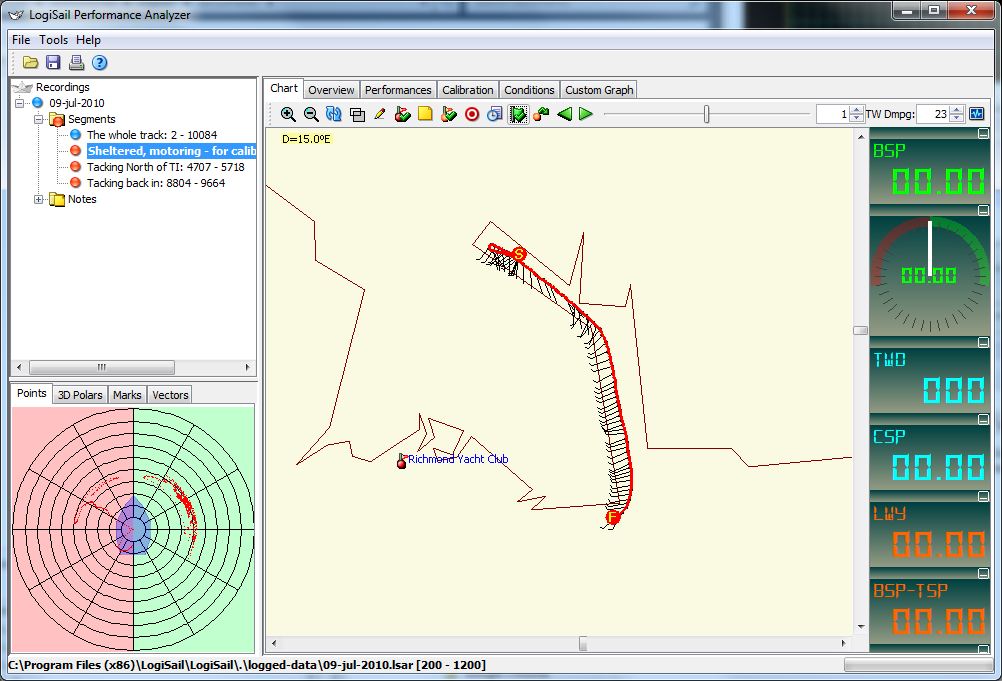
And definitely, the graph is showing current, and we knew there none.
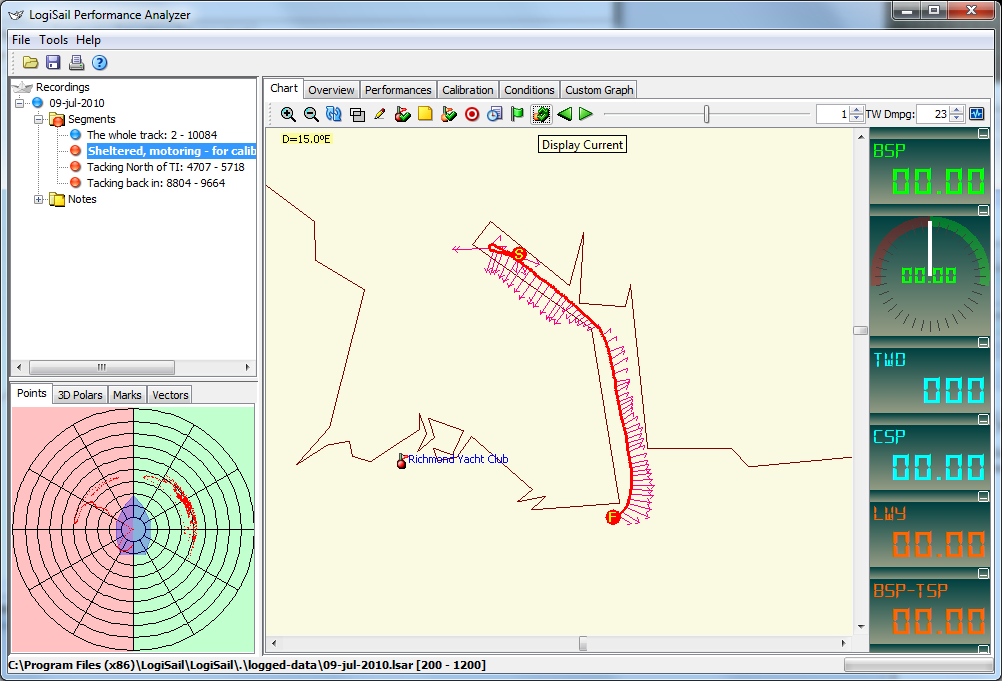
There is apparently a lot to calibrate!
Switch to the Calibration tab.
The first thing to do is to calibrate the compas, and the deviation curve,
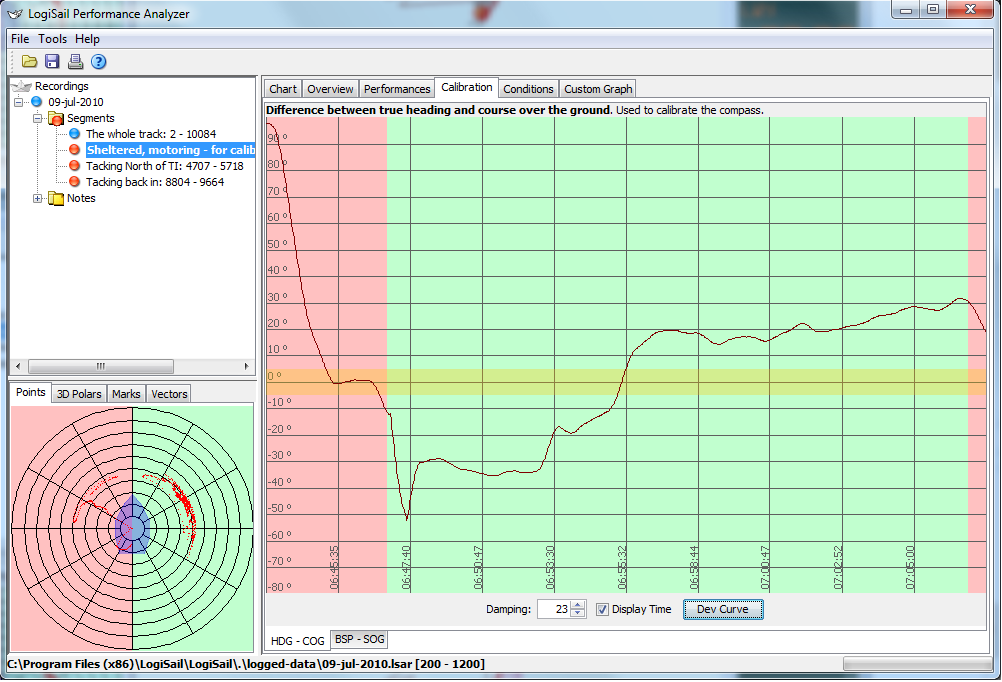
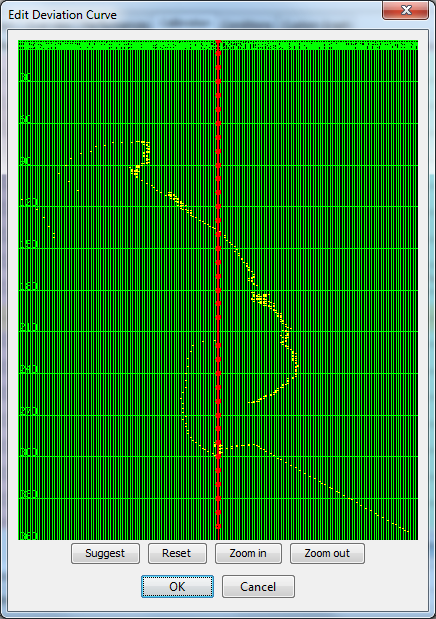
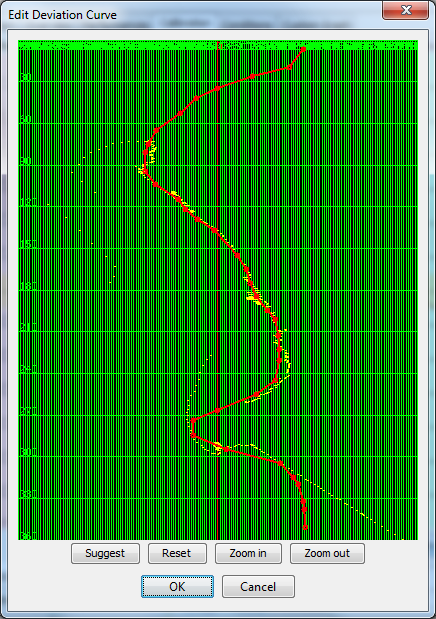
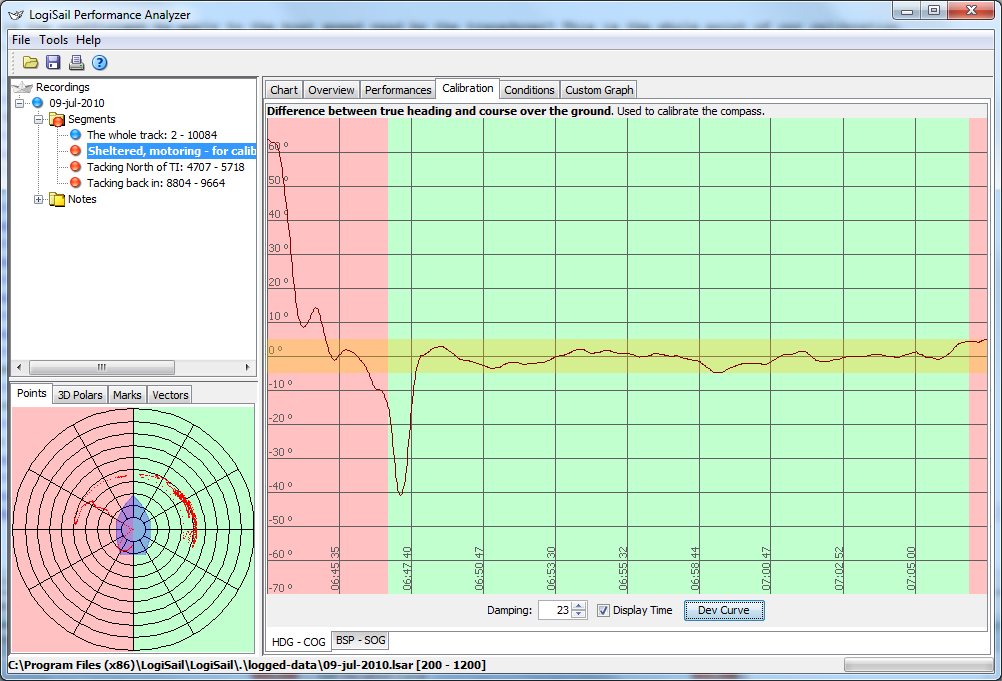
After setting the new deviation curve, the difference between Heading and Course Over Ground in much closer to zero.
This is quite an improvement.
Now switch to the tab showing the difference between Boat Speed and Speed Over Ground.
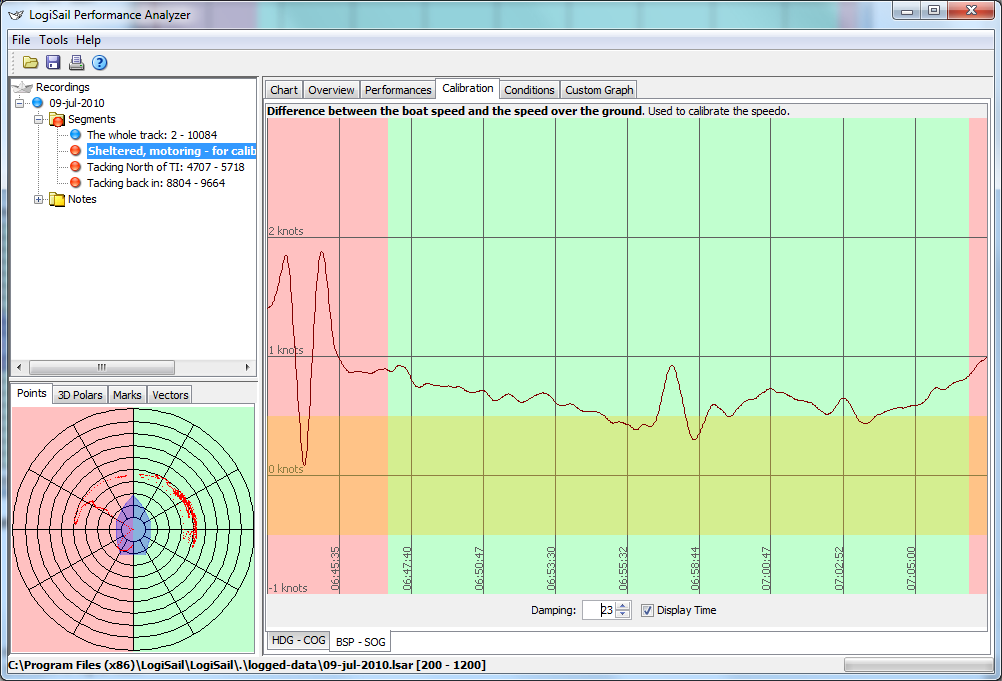
Apparently Boat Speed is too high. We want to launch the Calibration Wizard.
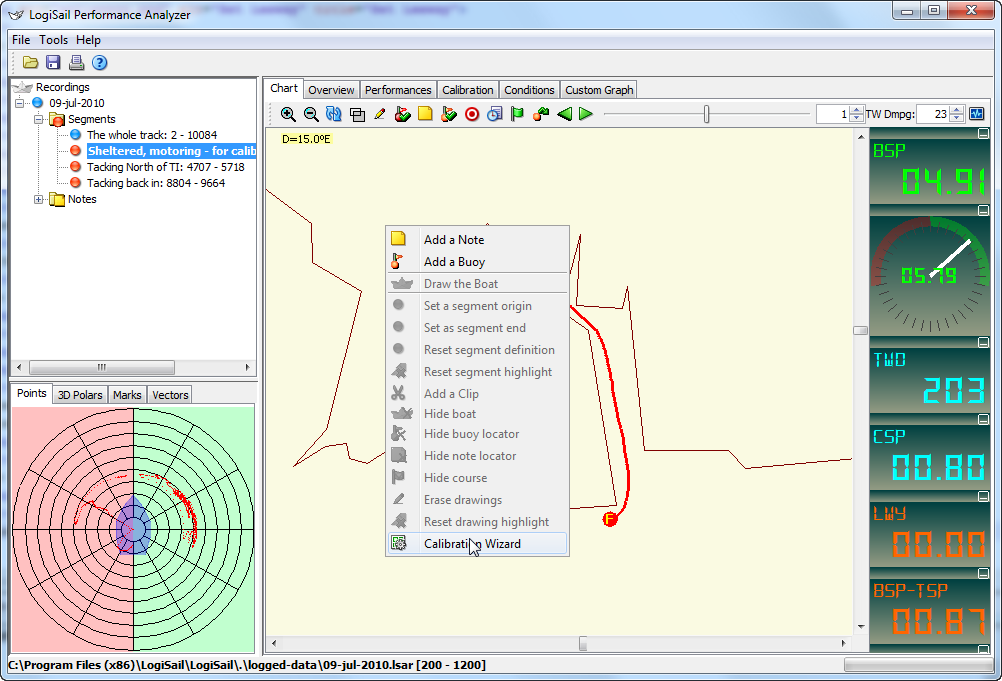
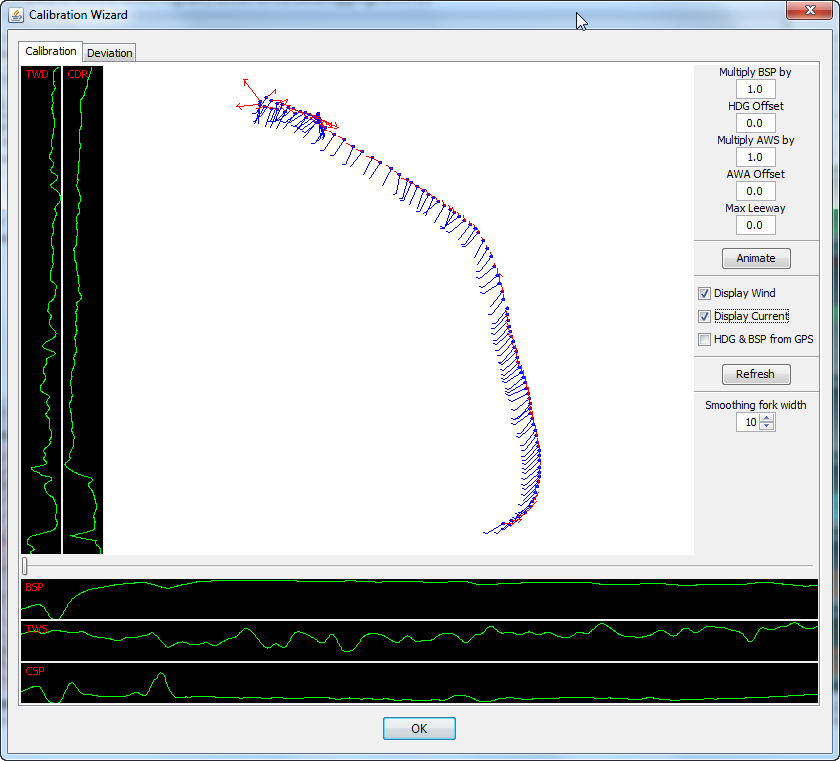
Hide the wind, to clearly see the current, and play with the field labeled "Multiply BSP by". Look at the bottom pane,
labeled CSP (Current Speed). With a factor of 0.875, the current speed is close to zero, we'll assume for now that this
is good enough. Click OK.
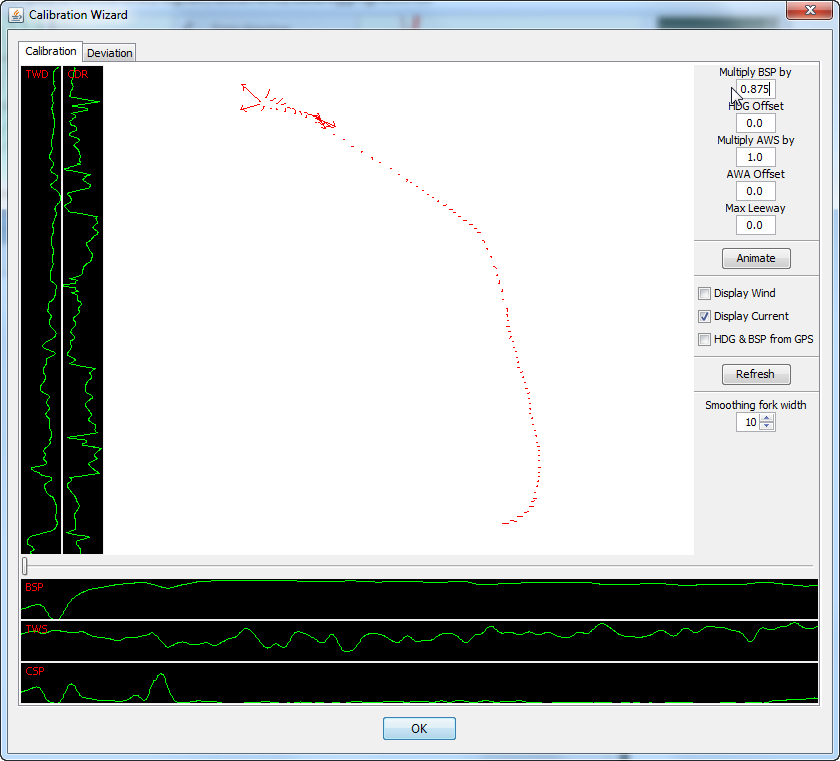
After reloading the data, and showing the BSP-SOG difference, we have the following graph:
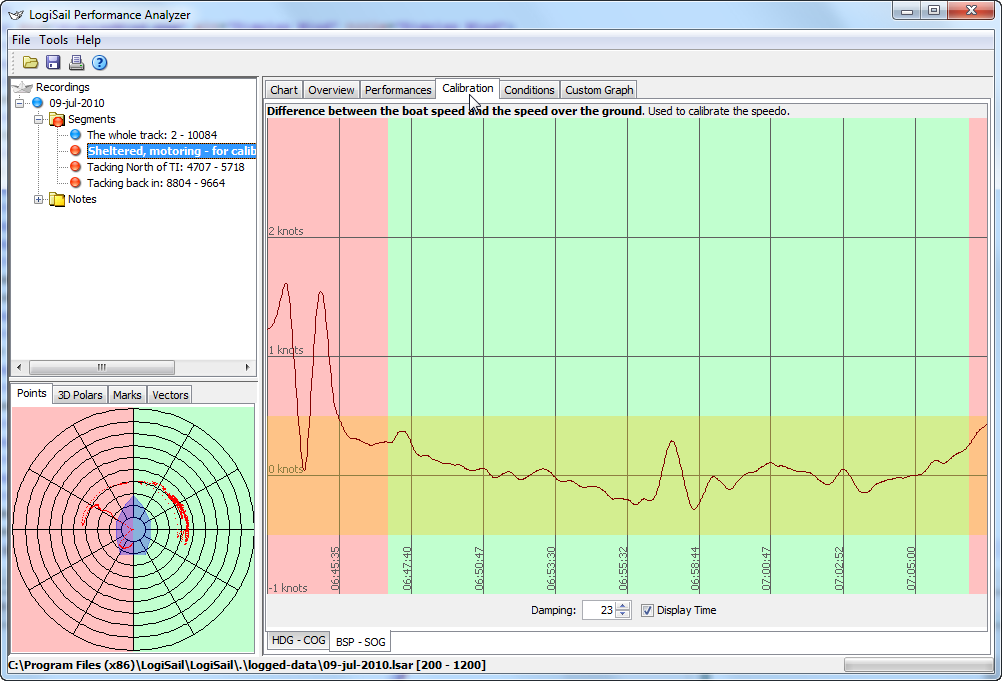
This is much better than before. The wind is steady, and there is no current in the sheltered section.
The speed factor (0.875) will have to be entered in the NMEA Station later on. At that time, the factor set at the
Dashboard level will have to be reset to 1.0.
2. Leeway
When compass and boat speed are correctly calibrated, you can now set the leeway. If the leeway is set correctly,
the wind and the current will keep steady (in speed and direction) when the boat is tacking, or changing direction.
This parameter can be tricky to set, as it depends not only on the boat, but also on the sea condition. It can even depend
on the mood of the driver...
© 2010 LogiSail.