VMG & ZMG |
Back |
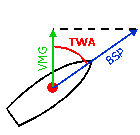
VMG stands for Velocity Made Good.
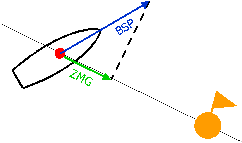
ZMG stands for aZimuth Made Good.
ZMG is also known as CMG (Course Made Good).
The VMG is the projection of the Boat Speed (BSP) against the direction of the True Wind.
The ZMG is the projection of the Boat Speed (BSP) against the direction of the next mark, which can be independent of
the wind direction.
|
|
|
The VMG should (ideally) be the same on both tacks. Unless your mark is right upwind or dead downwind, the ZMG is not the same on both tacks, which makes a huge difference.
Progression upwind or downwind is not to be understood as progressing toward a given point. The way to manage and understand those progressions are completely different. We are going to try to explain this difference...
The best VMG is obtained when BSP * cos(TWA) reaches its maximum (or minimum for downwind). The layline in this case is on both tacks given by the same TWA, as long as the wind does not change.
Determining the best ZMG on one leg follows the same rule. The ZMG is the best when the Boat Speed multiplied by the cosinus ot the angle between the route and the mark reaches its maximum value.
Where things begin to be very different is when it's about to determine where to change the course.
Unlike in the VMG case, where we can expect the performance to be the same when we appropriately tack
or jibe, as the wind is not involved in the ZMG calculation, the speed of the boat will more than probably change
on the other leg, and this change in speed will depend on the place where this change happened.
The best ZMG gives the route on which the progression in the direction of the mark is the fastest, and
not towards the mark.
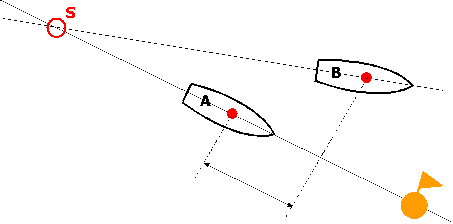
If A & B have left S at the same time, then the course of B
has a better ZMG than the course of A, even if it is longer in distance.
But what about comparing the two courses again when B will have to change his course to go to the mark?
Maybe at that time, A will have a better ZMG than B!
The big question for B is definitelly When to go to the mark ?
What composite route has the best ratio between speed and distance?
What composite route is the fastest?
And this calculation is pretty complex...
When the target is between the laylines, upwind or downwind, there is no problem. The solution is the same as for the VMG. The distance to cover on one tack will be longer than on the other, and that's about it.
Otherwise, computing such a route requires a good knowledge of the polars of the boat, and some good processing capabilities.
Considering that:
  for (alpha=directCourse; alpha<bestZMGcourse; alpha += ((bestZMGcourse - directCourse) / 10))
  {
    for (dist=0; dist<distanceToMark; dist += (distToMark / 10))
    {
      position = whatWeReachByFollowing(alpha, dist)
      timeToMark = timeFromOriginTo(position) + timeToMarkFrom(position)
    }
  }
We then have to find the course and distance for which timeToMark is the smallest.
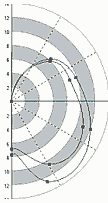
The result of such a computation may vary a lot, depending on the shape of the polars.
|
|
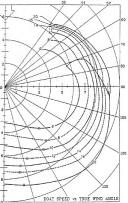
| Volvo 60' | J/105 |
As shown above, finding the right route might be critical on a Volvo 60 footer...
...more to come...